approach
What Guides our Work
We promote and defend human rights in Central America through an integrated strategy that includes:
- Protecting victims of violence and human rights violations (legal services, social and emotional support, organizing, training, and community development)
- Educating and mobilizing the public to engage in civic action in favor of human rights
- Engaging with media to build public awareness about important issues and human impacts of human rights violations
- Engaging governments at all levels to embed human rights principles in policy and public institutions
Mission
To defend human rights and promote democracy and justice in Central America.
Vision
We are defenders of human rights and the promoters of democratic rule of law. We are invested in a more just and peaceful future for northern Central America, whose rich history of resilience and hope in the face of violence and tyranny continues to inspire our work. We hold victims of human rights violations at the center of our work and recognize in them that we are all equal in rights and dignity.
Our Principles:
Excellence
We aspire to the highest standards in human rights practice, grounded in evidence, integrity, and accountability. Our work and governance reflect a firm commitment to transparency, rigor, and respect for the communities we accompany.
Interdisciplinary Collaboration
Human rights challenges are complex and deeply interconnected. That is why we bring together diverse experiences and knowledge, and work alongside victims, communities, and partners to advance truth, justice, and dignity.
Interculturality
We believe human rights are strengthened through dialogue across cultures. We value diverse ways of knowing and work to ensure that historically marginalized voices are heard, respected, and included.
Diversity and Inclusion
We are stronger when every person is valued. We open space for voices that have been excluded and perspectives that have been overlooked, because we recognize diversity as essential to justice.
Learning and Growth
We adapt, learn, and evolve alongside the realities around us. By reflecting on our experience and sharing what we have learned, we strengthen our work and deepen our impact.
our team
The People Advancing Justice in the Region
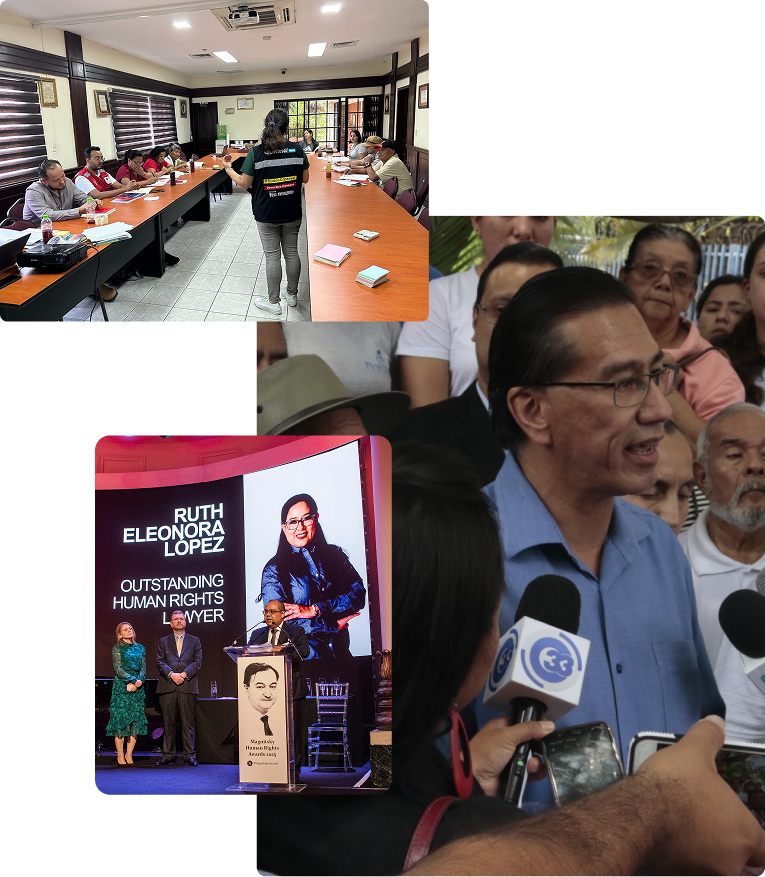
Our team is a diverse assembly of regional experts, from strategic litigators who challenge unconstitutional laws to forensic researchers who document the reality of the State of Emergency.
Explore Our Work
Cristosal is a regional human rights organization working across El Salvador, Guatemala, and Honduras. For more than two decades, we have defended rights, documented abuses, and supported communities seeking accountability and dignity.
Continue Reading →
Our Story
Cristosal grew out of relationships and a belief that communities can build more just and humane societies together. In 2000, the Very Reverend Richard Bower of the Episcopal Diocese of Vermont and the Right Reverend Martin Barahona of the Anglican Diocese of El Salvador planted the seed of Cristosal with the hope of strengthening ties between people in North America and El Salvador. Their vision was shaped by the Anglican Communion’s commitment to justice and human dignity, and by the Church’s role in defending human rights during El Salvador’s civil war.
A decade after the war ended, communities across El Salvador were still rebuilding from profound loss and displacement. Friends and congregations in El Salvador, the United States, and Canada came to understand that rebuilding meant more than addressing immediate needs. It also required confronting the injustices and human rights violations that had shaped the conflict and continued to affect people’s lives.
In 2010, when Noah Bullock became Cristosal’s first Executive Director based in El Salvador, the organization began focusing more directly on human rights. A guiding question shaped the work: Who is being harmed, and how can the tools of human rights help protect them? Listening to survivors and communities helped define Cristosal’s priorities, including internal forced displacement caused by violence, impunity for war crimes, discrimination against LGBTIQ+ people, and barriers to justice.
As these issues increasingly crossed borders, Cristosal expanded its work into Honduras and Guatemala. New partnerships and regional collaboration helped develop approaches to victim protection, human rights investigation, strategic litigation, and intercultural human rights education. Over time, Cristosal also became an independent nonprofit organization while continuing to draw inspiration from its faith-rooted origins.
What began with two people and a shared vision has grown into a multidisciplinary team of human rights defenders working across Central America. Lawyers, researchers, psychologists, political and social scientists, communicators, and organizers now work together to document abuses, defend rights, and accompany communities seeking justice.
In recent years, the region has faced increasing pressure on democratic institutions and civic space. In El Salvador, the detention of human rights defenders and the erosion of judicial independence have marked a new phase of repression. In May 2025, the unjust arrest of the Head of Cristosal’s Anti-Corruption Unit, Ruth López, a respected lawyer and advocate for transparency and accountability, became a stark example of the risks faced by those defending the rule of law.
In July 2025, amid escalating threats and legislation targeting civil society organizations, Cristosal made the difficult decision to suspend its in-country operations in El Salvador to protect its staff and the communities it serves.
Today, Cristosal continues its work from Guatemala and Honduras, documenting abuses, supporting victims, and defending civic space across the region. Even in difficult circumstances, the organization remains guided by the same commitment that inspired its founding: standing alongside those seeking justice and dignity.